
It’s late July, a blisteringly warm day for the middle of England, I’m travelling with a colleague, and we are talking about the uncharacteristically hot summer and I confess that I’m anxious about how blasé people are about these endless heatwaves; “this isn’t hot, you should have been here last week” (when it’s 28 degrees), or “it’ll rain soon enough, lets enjoy the summer while it’s here”. I’m concerned that seeking solutions or even adaptations to changing conditions are less likely while we continue minimise or deny the seriousness of the situation we are in.
My colleague challenged me then with a very direct question; “If you could get everybody in the world to do one thing – one thing that is in their control every day – to help nature recover, what would it be?” I answered immediately, without hesitation “Consume less”. “Don’t buy so many clothes. Don’t drive when you can walk. Try to reduce your food waste.
Just generally consume… less.”
After I had spoken I paused. Reflected and started doubting my answer, Why had I blurted that out? what about….? Or any one of a million answers I could have provided.
It was July 30th. As it happened this year, Earth Overshoot Day; the point in the year when humanity has used all the biological resources the Earth can regenerate in 12 months. Simply put, if the Earth produces 365 Earth-days’ worth of resources each year (one for every day), we’ve used all 365 Earth-days’ worth in 211 days. Everything we consume for the rest of the year is, in effect, an ecological overdraft: 155 Earth-days’ worth of resources the Earth will not be able to regenerate.
According to the latest figures from Global Footprint Network, humanity is currently using nature around 73% faster than it can regenerate. In other words we are using limited resources as if we had 1.73 Earths available to us. The results of this consistent overshoot are seen in more frequent extreme weather, declining biodiversity, soil degradation and reduced crop yields as well as highly polluted water system.
This is true for the global population but not all countries consume at the same rate. The image below from Earth Overshoot Day website illustrates date of overshoot if the global population were to live like the population of individual countries.
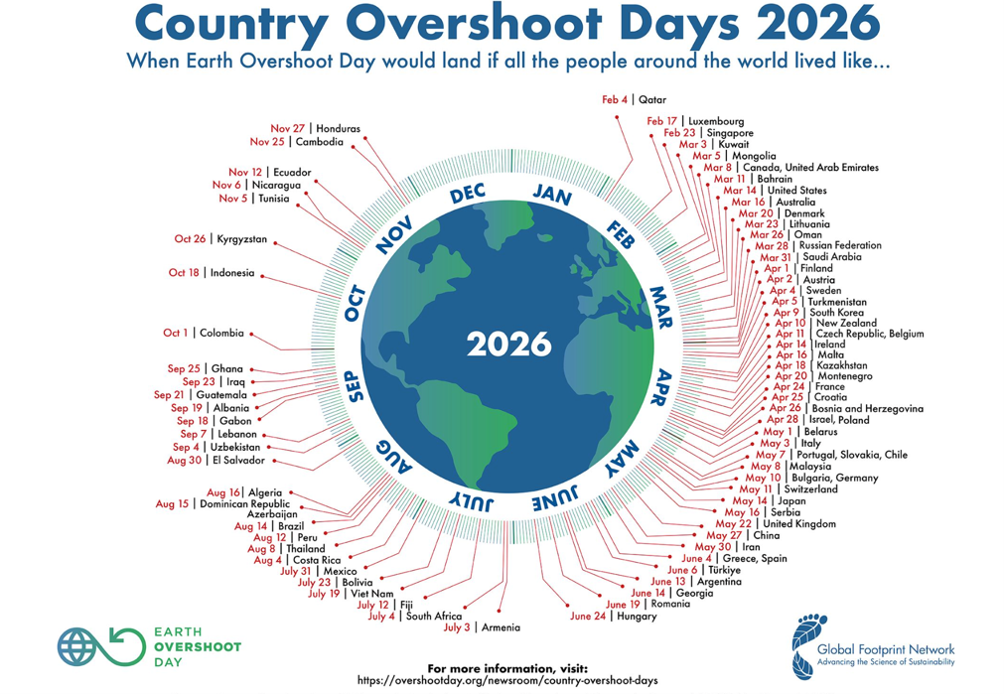
So, it turns out that my instant response to his question was on the money. If we all consumed just a little bit less, less fuel, less food, less fashion, less travel, and invested instead in supporting nature and in creative, rather than consumptive, recreation, then not only would our quality of life be improved and our banks accounts less pressured but we would also help shift overshoot date later in the year. That would be good news for all of us.
Although living consciously, maintaining an awareness of the destruction that our consumption enables, is hard work and requires change and some sacrifice it ultimately supports the planets ability to nurture us and maintain conditions that are supportive to our lives upon it.
-Kathryn Soares